Project · 2011–2026
Sistemas Acadêmicos em Oracle PL/SQL
14 years evolving a higher-education institution's core: a 3.8 TB, 7.7-billion-row Oracle database where enrollment, exams, bank billing and ERP migrations coexist — all in PL/SQL, on production only, with no staging since 2023.
Fourteen years on the same production database — and, since 2023, with no safety net at all — teach what no framework can: every change must be born small, reversible and documented.
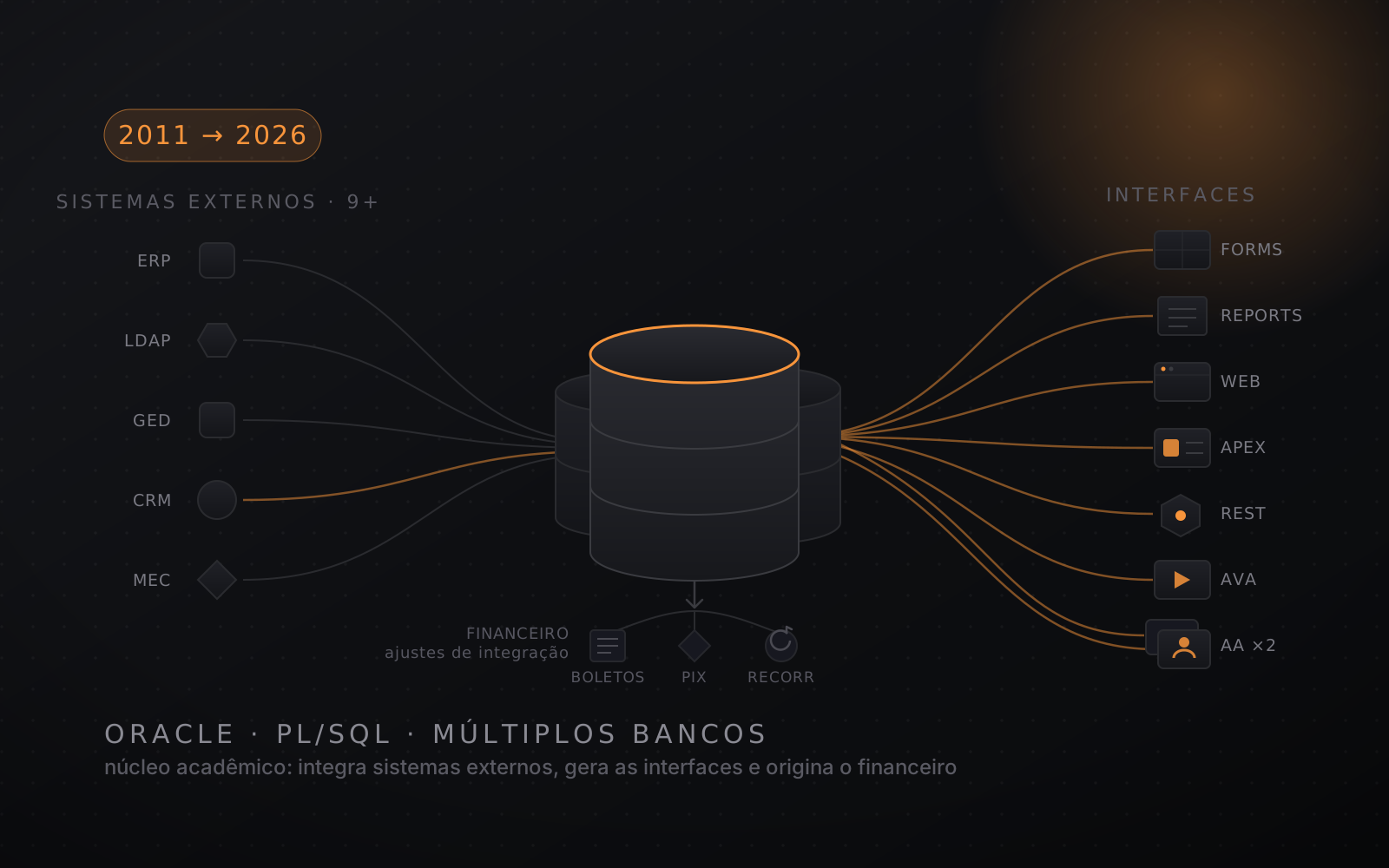
It's where my career began and the system I know best: a higher-education institution's academic-financial core — a 3.8-terabyte Oracle database with 7.7 billion rows across 7k tables: 1.8 million people, 750k students, 23 million course-enrollment records. The authorship trail in the source runs from December 2011 to today: about 180 production objects created or changed by me in the central packages, plus 134 in my working schema.
The core is PL/SQL: the enrollment and re-enrollment packages (credit validation, equivalences, automatic advising), the distance-learning exam engine, the electronic gradebook's average calculation, and the graduation-and-diploma track. On top of it, I maintained the other layers: Oracle Forms screens and Reports, the student self-service portal in Java with Spring MVC — 195 files and 52.7k lines carrying my signature, across both generations of the portal — and web pages generated by the database itself.
The domains are the unforgiving kind: bank billing — the ecosystem I evolve has issued 34 million payment slips and processes remittance and return files for 15 banks, each with its own layout —, government scholarships and the Ministry of Education's regulatory obligations (national exams, census, diploma registry). In March 2020, when in-person operations closed, the online entrance exam went live within the same week.
Working at this scale changes the engineering: there is no row-by-row loop. The heavy routines move millions of rows per pass with BULK COLLECT and FORALL, accumulate subtotals in memory with associative arrays instead of re-reading the database, partition what grows without end, and read binaries in blocks so memory never blows up. It's big data with no cluster — the data is large, the machine is a single one, and the yardstick is always the right technique for the volume: the institutional enrollment report (61 million rows and 182 columns) is rebuilt every day by a routine I rewrote to write the whole result in two INSERTs, and distance-learning exams and billing run on async queues inside the database itself.
I've been through two ERP transitions — in the most recent one, I built the migration pipeline in pure PL/SQL: 16 million records reconciled in staging, with controlled financial locking during the cutover. And since 2023 that environment gained a discipline-forging trait: the development and staging databases were decommissioned, so every change is born in production — with a changelog in the source and a rollback plan before applying.
By the numbers
- 14
- Years in production
- 7,7 bi
- Rows in the database
- 3,8 TB
- Of production data
- 7 mil
- Tables in the system
- 10.390
- PL/SQL objects in the ecosystem
- 61 M
- Rows in the daily report
- 34 M
- Slips in the ecosystem
- 8,2 M
- Distance exams generated
- 16 M
- Rows migrated from ERP
- 195
- Signed Java/JSP files
- 0
- Staging since 2023
Engineering decisions
- 01
The binary the documentation says cannot cross
To issue the digital diploma I needed the scanned document, which lives in another database. Oracle's documentation is explicit: a pointer to a binary file selected from a remote table cannot be used locally — the database refuses. The obvious way out would be an intermediate service; the way I found needs none. Instead of reading the remote pointer, I materialize the binary straight into a local temporary table with a single insert statement fed by the remote query: from there the file is local and workable. Then I read it in 1,440-byte blocks — a multiple of three, so base64 padding never corrupts the seams between blocks — and assemble the JSON. A three-byte detail is the difference between a valid diploma and a corrupted file.
- 02
I led the migration of the entire application platform
Migrating a forms-and-reports platform from one major version to the next is not copying files: every module must recompile, and whatever fails to compile has to be understood and fixed — one by one. I led that migration in the academic system and assembled the estate running today: 1,622 forms and 1,052 reports recompiled, revalidated and edited where needed, plus the shared libraries and remote directory configuration. The source archive held nearly twice as many modules, between versions and duplicates; what reached production went through curation. That estate is still live.
- 03
Digital diploma: I led the move from paper to a legally valid document
I led the project that replaced the paper diploma with a digital one — a legally valid document, a regulatory requirement, no room for a wrong field. The package I wrote orchestrates the whole cycle without leaving the database: it validates twenty rules before letting a record out (course hours must match the curriculum matrix, accreditation orders must exist and not be duplicated, the official gazette page must be numeric), builds the JSON and fires the authenticated request to the registrar's API, with an HTTPS wallet and credentials read from an encrypted parameter. Register, query and annul; plus a queue with a five-minute job reconciling each diploma's state. 35 thousand digital diplomas issued.
- 04
The report the Provost reads every morning
The enrollment map — 61 million rows and 182 columns rebuilt by a nightly routine — used to overrun its window. I rewrote the engine to accumulate subtotals in memory, in associative arrays keyed by text, and write once at the end: the whole package holds just two INSERTs. The table audits when each row is born, so the effect is measurable across a 20-year series: the typical generation window fell from 19 to 9 minutes, the p90 from 58 to 24 — the best level in the entire series — and the 8-hour-plus nights, once dozens per year, all but vanished.
- 05
Exam grading taken off-screen (2016)
Distance learning generates exams by the millions and synchronous grading froze the student's experience. I turned the flow into a queue: answers land in a table and a job grades them in the background — what today would be called an async worker, built with the parts Oracle 11g offered. The production table holds 8.2 million exams.
- 06
Online entrance exam in lockdown week
Between March 18 and 22, 2020, the in-person entrance exam ceased to exist. The online exam routine went into production within that same window, reusing the distance-learning exam engine — and admissions never stopped. Years later, the same package gained the CRM integration queue.
- 07
ERP migration with a financial lock
Migrating academic and financial history with the system live takes more than ETL: 25 staging tables with 16 million reconciled rows, curriculum-matrix mapping between the two systems — and a trigger that locks the invoices under migration, so no charge is born wrong during the cutover.
- 08
The classic problem, solved once
A trigger reading the very table that fired it is Oracle's most classic trap (the mutating table). Instead of N scattered workarounds, one central package holds the pattern — per-session in-memory state — and the system's triggers delegate to it. Legacy has architecture too.
- 09
Real-money rules
The enrollment-kit payment slip, a reprint flow that refuses to print bank-rejected invoices, debt renegotiation, automatic enrollment confirmation for scholarship students above 75% completion. Financial rules where a wrong if becomes an undue charge to a real student — the domain where I learned to verify before trusting.
- 10
The database as a hub: the integrations, by name
From inside PL/SQL, the system talks to the whole ecosystem: payroll, LDAP and Google accounts, document management (DMS), the library, the CRM (candidate queue), the regulators (diploma registry, census, national exams) — and it feeds the data platform. Payments get a chapter of their own: Pix, online slip registration at two banks and card recurrence go through Node middlewares that handle the modern TLS the database can't negotiate. And in the opposite direction the database also serves: 108 REST endpoints across 18 modules, with 57 million fully-audited calls.
- 11
The Java layer: the student portal on top of the database core
What the student sees — re-enrollment, certificates, distance-learning exams, invoices, agreements, diploma — is a Java portal that crossed two generations, and I crossed both with it: 195 files and 52.7k lines carry my signature in version control, 72 of them in Spring. The architecture is honest about what lies beneath: the Spring MVC controller takes the request, the DAO calls the PL/SQL packages as stored procedures — direct JDBC, no ORM in the way — and the response returns as JSP. When the portal was rewritten, 28 of my files reappeared in the new generation: I ported my own modules instead of leaving them in the legacy. Along the way the platform moved from the OC4J container to WebLogic and the runtime jumped from Java 1.4 to 6 (with the code kept at level 5, so nothing already running would break); I did not lead the start of that migration — I validated it and made sure everything worked again.
- 12
When the test environment disappears
Until 2023 there were development and staging databases; both were decommissioned and only production remained. When the safety net goes, the process becomes the environment: small changes, a dated changelog in every package header — a pattern I kept for 14 years, and the reason this entire work history could be reconstructed from the system itself — and one question before every apply: "how do I undo this?". It's the same discipline I carry to any stack.
Architecture
Interfaces
Forms · Java · PL/SQL Web
1,622 forms and 1,052 reports, the student portal in Java/Spring MVC and pages generated by the database itself.
Núcleo PL/SQL
Business rules
Enrollment, exams, graduation and billing: ~10k objects in the ecosystem, with my authorship in the central packages.
Big data
Volume with no cluster
BULK COLLECT, FORALL, associative arrays and partitioning — moving millions of rows with no row-by-row loop.
Triggers & Jobs
Reaction and background
Auditing, consistency and async queues; 88 scheduled routines inside the database.
Cobrança
15 banks + PIX
Remittance and return files with a per-bank layout; 34 million slips in the ecosystem I evolve.
Migração de ERP
Cutover with no wrong charge
25 staging tables, 16 million reconciled rows and a financial lock during the cutover.
Integrações
Payroll · LDAP · DMS · Gov · CRM
The database as a hub: web services, exports and regulatory loads.
Operação
Production only
No staging since 2023: a dated changelog per package and a rollback plan before every apply.
Stack